I sat in the pew waiting for my turn. My classmates sat spread out across the sanctuary in the quiet, dark church. Our teacher instructed us to reflect solemnly on our sins as we prepared to enter the confessional. I was 13 years old, a middle school student at a Catholic parochial school. I had my usual litany of sins ready and rehearsed to tell the priest: “Forgive me Father for I have sinned, it has been one month since my last confession…I have disobeyed my parents, lied, and had lustful thoughts.” It was the same script I said every time we were forced to participate in this sacrament at school.
I never would have admitted it at the time, but I dreaded the sacrament of Reconciliation. It made me feel anxious. Sitting in a stuffy and confined room, divulging my sins to a priest sitting behind a screen. The experience was neither comfortable nor meaningful. It was just another ritual, another prayer to recite, another rule to follow. It was all part of a religion that did not feel personal to me.
In my college years, I made an intentional choice to step away from the Catholic faith. Hell had always felt one sin away when I was growing up, and I wanted to let go of that feeling of condemnation. I did not have any personal resentment toward Catholicism or its teachings per se; I just wanted to distance myself from the sense of guilt and obligation that had defined my childhood experience.
In my senior year, a series of painful life events brought me to a crisis of faith. Out of a desperate desire for healing and hope, I started to involve myself in Christian ministries on campus. At a spiritual retreat, I rededicated my life to Christ, and after graduation, I enrolled in a year of discipleship at a charismatic church on the West Coast. It wasn’t a traditional path to take, but I was eager to pursue a new relationship with Jesus.
The church I joined was worlds apart from the Catholic Church in which I was raised. In fact, when I would tell others that I was raised Catholic, they would give me a sympathetic smile and nod, as if to say, “How ever did you survive that?” The church encouraged speaking in tongues, spontaneous prophetic prayer, corporate worship, and discipleship. They adamantly preached “relationship, not religion,” and were intent on setting themselves apart from other denominations that they claimed were focused too much on rules and not on cultivating a personal connection with Christ. I spent those years of my life dismantling my long-held beliefs about the concept of religion, questioning much of what I had been taught as a child. While it was healing in many ways, it was, at times, confusing. I had hesitations about Catholicism, but I did not necessarily share the same contempt for it that many other people did.
Sadly, this church eventually unraveled due to a controversy surrounding leadership. It caused quite a fallout amongst its members. Many members left the church bitter and hurt. For some of us, like myself and my husband, it initiated a period of disillusionment and separation from organized religion as we watched our community, and other similar churches, experience a painful dissolution. If this was the right way to do religion, then why did it all go wrong?
A few years later, I returned to the East Coast to start a new job at my Alma Mater, an all-girls Catholic high school. During the first All-School Mass I attended, I was moved to tears. After years of not attending Mass, the beauty and reverence for the Eucharist, the homily, the music, the prayers suddenly felt brand new to me. For the first time in a long time, the communion of believers felt alive.
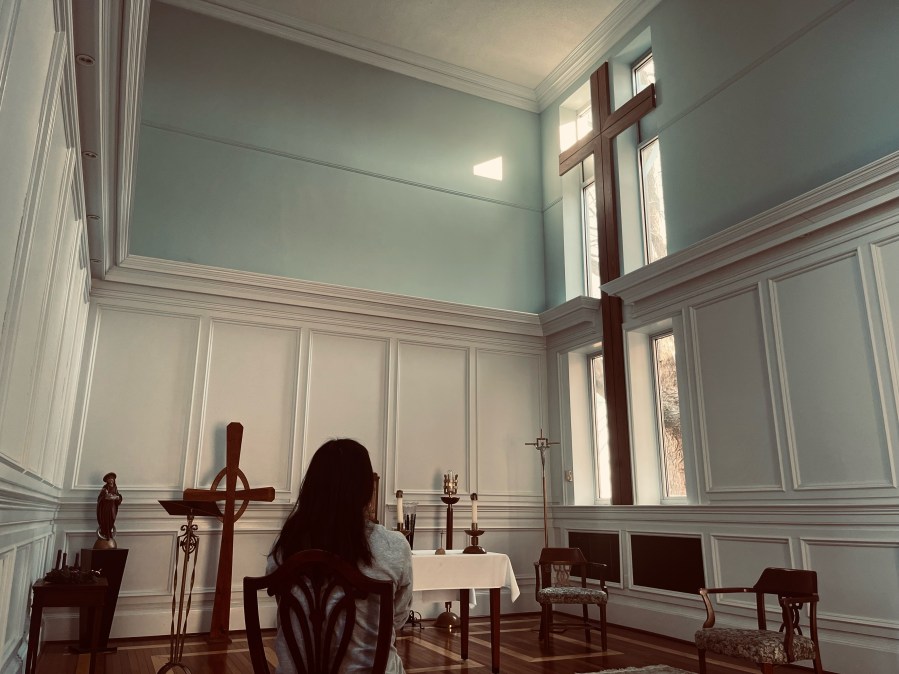
A few weeks ago, I attended a weekly optional Mass in our school’s small, cozy chapel. A handful of colleagues and high school students sat next to me. The priest donned crimson vestments in honor of St. Andrew, the martyr. The morning light streamed in through the tall chapel windows, illuminating the Ciborium as Father performed the liturgy of the Eucharist. In those moments, as Father led us through prayers and the consecration of the host, I felt so deeply aware of Christ’s presence in that room and His gentle love, which calmed any anxiety and restlessness in my heart. I felt at peace with myself and with God.
In the return to my Catholic faith, this season of my life has been a time of self-reflection and reopening my mind and my heart to the blessing in each Catholic sacrament. I have come a long way from that little girl sitting in the pew, dreading Reconciliation. It’s not the guilt or obligation that motivates me to pursue Christ through the Sacraments, but the opportunity to receive His grace and love. For me, the ritual of it all is not robotic and meaningless–it is beautifully intentional, real, and sacred.
In Philippians 3:8, Paul writes: “I count all things to be loss in view of the surpassing value of knowing Christ Jesus my Lord, for whom I have suffered the loss of all things, and count them but rubbish so that I may gain Christ.” I have spent much of my life questioning which “way” is best: which denomination is best, which kind of prayer is best, which kind of communion or worship is best. And while I still have my own questions and uncertainties about the Catholic faith, I am confident in this: Christ is The Way, and if I set my heart on knowing and loving Him, then everything else will come into focus.
Maika Walker is the Director of Social Justice at the Academy of the Holy Cross.
 Millennial