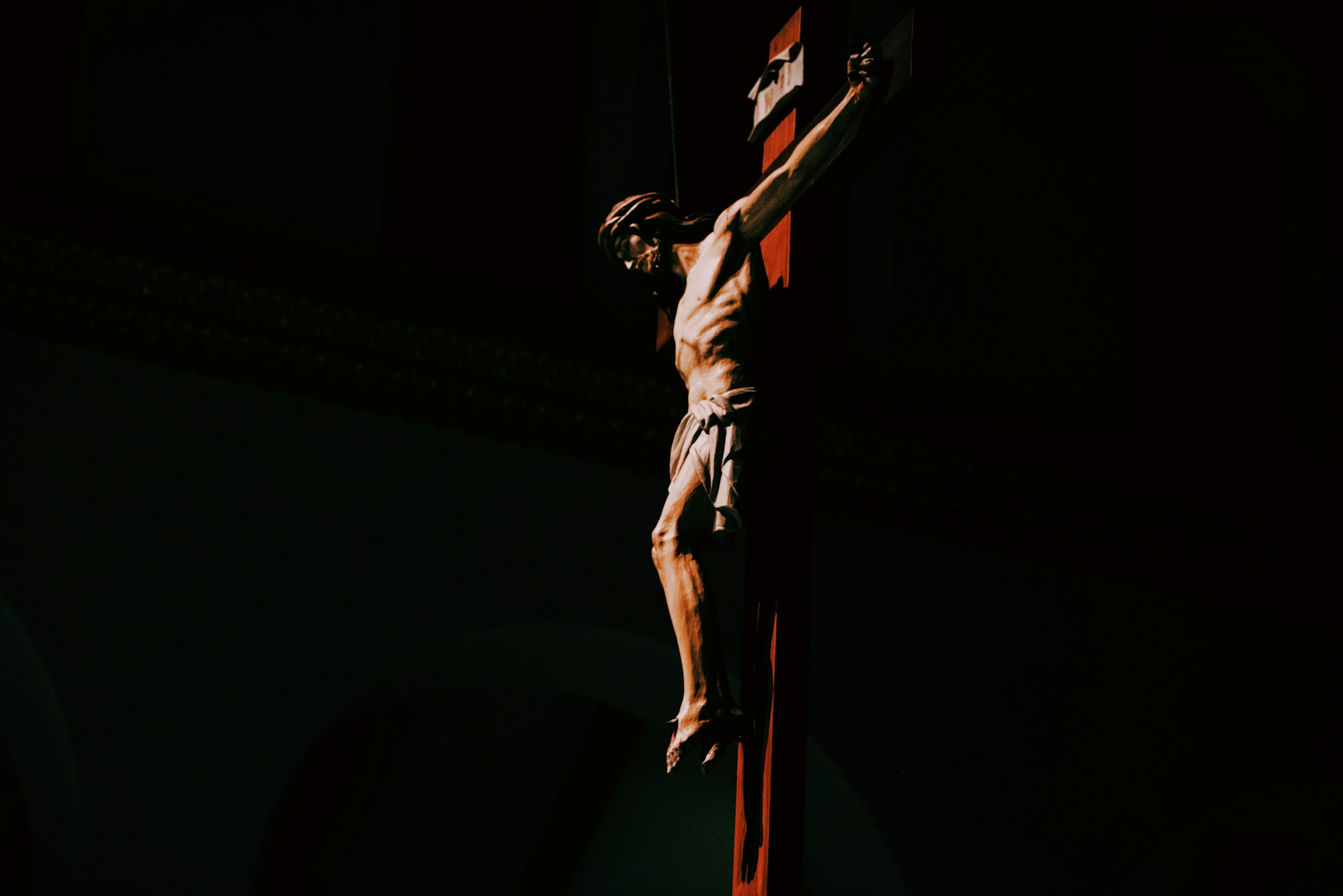
In our Gospel today, Jesus tells his disciples:
“As I have loved you, so you also should love one another.”
What does this really mean—“As I have loved you?”
How did he love them?
He called them.
He listened to them.
He healed them.
He fed them.
He led them.
He taught them.
He trusted them.
He forgave them.
He embraced them.
He washed their feet.
He performed miracles.
And finally, Jesus united himself to their suffering—and ours—by allowing himself to be buffeted, nailed to a cross, stabbed in his side, and left to die. Suffering and overcoming death was his ultimate expression of love.
We sometimes use the term “love” in overly sentimental or vague ways.
The love Jesus demands is not sentimental, it is fundamental. It is not vague or soft, it is everything.
He has shown a different way forward. He has shaken up how we think about power and status. Power is not expressed through force, it is expressed through love. Success is found in humble service.
This is what victory looks like. It is not the victory of a military or a political party, it is a remaking of our entire existence through love—a love that overcomes all other powers and even conquers death.
And so, with this in mind, in our second reading, Paul and Barnabas went from place to place and won large groups of converts.
I was tempted to ask Chat GPT to rewrite lyrics to the song “I’ve Been Everywhere” using the names of the places to which they traveled, but I won’t.
Lystra; Iconium; Antioch; Pisidia; Pamphylia; Perga; Attalia.
The point is, they traveled thousands of miles. And they were winning converts by spreading a message of love and truth.
We can only serve as successful missionaries if we first draw closer to Jesus. We do not do good deeds for our own standing, we do them because Jesus has loved us first—and loved us to the end. Our love will be more authentic, more powerful, and more meaningful when it is rooted in our relationship with Jesus.
We must know Jesus well if we want to love others well. Christianity is not an identity or an interest group; it’s a relationship with God. Everything needs to flow from there.
Hardship and sacrifice
Of Paul and Barnabas, we are told, “‘They strengthened the spirits of the disciples and exhorted them to persevere in the faith, saying, ‘It is necessary for us to undergo many hardships to enter the kingdom of God.’”
This is a reminder that even a victorious, joyful Christian life is not perfect. We will face hardships. And it does not mean that we pretend everything is okay even when it is not! Christians do not need to fake our way through loss, conflict, illness, or hardships. But we do need to draw close to the Father and remember, in the deepest part of our being, that he has drawn us to himself and will never let us go. We are not a people of blind optimism; we are a people of perseverance. And we are called, in turn, to help others persevere.
Fr. Walter Ciszek provides many examples of amazing perseverance in his books He Leadeth Me and With God In Russia, in which he tells stories of being in solitary confinement and in labor camps in Russia during the last century. One thing he learned was, “God is constant in his love if we will but look to him, he will sustain us in every storm if we will but cry out to him, he will save us if we will but reach out our hand to him. He is there, if we will only turn to him and learn to trust him alone. The upheavals in this world, or in the Church herself, are not the end of everything, especially of his love. They can in fact serve best as signs to remind us of his love and of his constancy, to make us turn once more to him and cling to him again when all else that we counted on is overturned around us.”
Paul, too, was no stranger to imprisonment! He was often writing from jail or while anticipating going there. But Barnabas and he understood that they were part of an eternal project, and they were called to do their part in their time and place—no matter what.
This eternal component is so important to remember. The kingdom of God was being built long before you or I were conceived, and it will continue long after we are in the ground. But, as Sister Bethany Madonna of Sisters of Life once said, “There was a moment where God said, ‘Not another day without you.’” He loved you into existence, and you have a purpose on this Earth: we are all called to help build this kingdom.
Where are they now?
A final word on the eternal nature of this call to love:
Barnabas was martyred.
Paul was beheaded.
Again, far from a sentimental love, they were willing to give everything—including their lives—for Jesus. This was the ultimate expression of love. You and I inherit their legacy.
This reminds me of a scene that was described a few times during the recent conclave. Many commentators noted something about the location of St. Peter’s Cathedral and the history of the Church. In the middle of St. Peter’s Square, standing amidst the crowds cheering for the new pope, stands an obelisk that was once at the center of the Roman circuses in which Christians were often crucified.
Catholic commentator Bishop Robert Barron says it is likely that this obelisk was the last thing that St. Peter saw on this earth as he was crucified at the direction of the roman emperor, Nero. In earthly terms, this was a victory for the emperor, a show of his worldly power. A defeat of the former fisherman who had been leading a Jesus-centered movement.
But emperors don’t have the last word; God does.
Let’s move past the gruesome scene from almost 2,000 years ago and think about the joyful scene in that square when Pope Leo XIV appeared to cheering crowds and chants of “Viva il Papa”, “Long live the Pope.”
At a previous conclave, Francis Cardinal George is said to have looked at a similar scene and raised a question along the lines of, “Where is Nero now? Where is Caesar? Where are their descendants—and who cares?”
But we know where Peter is. We know, joyfully, where his successor is. Peter’s Church, Christ’s Church, lives. And each of us has our own role to play in the continuous building up of this Church.
Some day, as our reading from Revelation tells us, God will wipe away every tear from our eyes, there shall be no more death, mourning, wailing, or pain.
Let’s simply do what we can to prepare—through our works and through our prayers.
Chris Crawford is our newest writer at Millennial.
 Millennial