Note: This is a personal reflection and does not reflect the viewpoint of any affiliation that I hold or employers I have or had.
Over the course of the past week, much has been said regarding the glory of Jesus in our public life. In the wake of the horrific assassination of Charlie Kirk and the memorial service that filled a Phoenix football stadium, there are talks of “revival” in the American church.
From the limited clips that I have seen of the memorial, we witnessed a stark contrast within the expressions of Christianity that were presented. If we are seeking a revival of Christian faith in our public life, we should be careful what we wish — and pray — for. And we should consider what scripture actually calls for.
I’ve been troubled by the calls for vengeance. Revenge belongs to the Lord, scripture tells us. What’s more, too many leaders have been quick to blame an amorphous “them”, falsely claim that there is an organized violent effort, and called conservatives to a war footing.
Republican Utah Governor Spencer Cox rebutted this well when he said that his faith and his view of politics informs him that individuals are responsible for their own actions. We should call all leaders in the public square to avoid the language of violence and dehumanization. Such words harm our souls and damage our public life. However, the language of vengeance and war will not lead us closer to Christ; they will lead to more division.
This is part of a troubling trend that we have witnessed in Christianity in recent years: A rejection of the teachings of Jesus Christ as not applicable to our current moment. I have seen this from friends who have refused to pray for Donald Trump or who have even wished harm upon him. And we have witnessed this on a large scale within some conservative expressions of Christianity.
Christianity Today’s Dr. Russell Moore has heard from many pastors whose flock have told them that Jesus’s words to “turn the other cheek” are “weak”, and cannot be followed during our times.
Similarly, some brands of Christianity embrace a divisive brand of “us vs. them” politics that focuses on finding and defeating enemies. At the memorial service last week, the president noted Charlie Kirk’s own love for his enemies in the context of scripture, but then rejected that approach. “I hate my enemies,” he declared.
We are in challenging times right now, to be sure. We do see unimaginable expressions of evil and harm — including against the most vulnerable. However, it is extremely dangerous to imply — or directly state — that Christian sacred scripture does not apply during these difficult times. In the face of our current culture, we need to crack open our bibles and read them more closely — not shelve them.
If we are not living up to the standard to love our neighbors and love our enemies, we are rejecting words that Jesus told us quite clearly.
Think for a moment of the prideful nature of claiming that Jesus did not understand our so-called enemies or the stakes of our politics today.
Jesus lived under the occupation of a Roman dictatorship. He was sought for punishment by both the religious and secular authorities — and an angry mob that refused to let him go. He was killed by the state, on a cross that was designed not only for execution but also for humiliation.
Rejecting the teachings of Jesus in our current, troubled time is not just bad sense, it’s not just politically foolish and a-historical — it’s blasphemy. To say that the nonviolent teachings of Jesus Christ are not applicable to this moment is a lie from the pit of Hell. To act as though Jesus does not understand our current moment is a rejection of his death and resurrection.
We cannot say that Jesus’ words about our enemies do not apply to us and also say that at the name of Jesus every head shall bow and every knee shall bend.
We cannot read the Good Samaritan parable and try to convince ourselves that we need to be more scared of our stranger on the side of the road than the Samaritan was.
We must accept Jesus’s call to turn the other cheek and reject our own instinct toward vengeance. Turning the other cheek is not just about the dignity of the people who oppose us — it’s about claiming our own dignity.
Ronald Reagan once said, “If we ever forget that we’re one nation under God we will become one nation gone under.” We are in a particularly dangerous place when our civic and political leaders claim the words of Jesus on their lips and then explicitly reject his teachings by their words and actions.
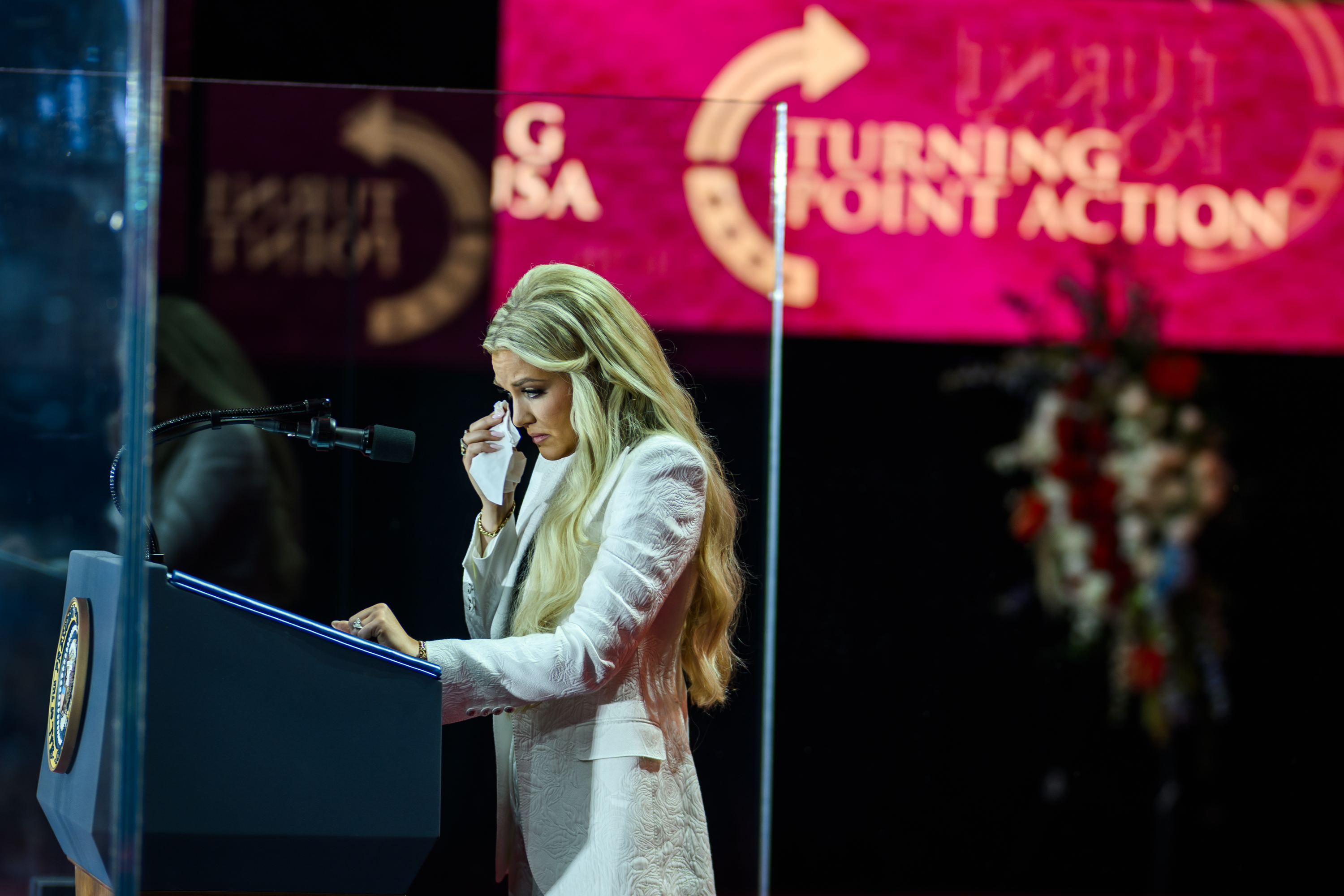
Erika Kirk has shown us a better way. In her speech at her husband’s memorial, Mrs. Kirk said of his killer, “I forgive him. I forgive him because it was what Christ did, and it is what Charlie would do.” The crowd rose to their feet in applause.
One of the themes of Erika’s memorial remarks was that if we pray for God to use us, those words have power. When we surrender ourselves to God, it can be dangerous to our earthly lives. “Thy will be done,” does not guarantee comfort and it does not conform us to this world — it brings us to higher ground.
This is what true revival looks like: Forgiveness, meekness, charity, forgiveness.
Erika Kirk’s words are inspiring further forgiveness.The actor Tim Allen has said that Erika’s example finally led him to forgive his own father’s killer.
This reminds me of the words of Michael Gerson at an event of The Initiative on Catholic Social Thought and Public Life in 2018:
“There is a worldly definition of organization and the exercise of power. But when I look at the moment that Christian people communicated most about the nature of their faith over the last several years, it was after the Charleston church shooting; when the families of those who suffered forgave the man who had taken their family members.
It was an example of grace, not anger.
Grace, not resentment.
Grace, not organization for power.
And that is the comparative advantage that Christians have in the broader culture — that when they act by the values and attitudes that characterized Jesus Christ, it speaks across every boundary. It reaches people of every background… And I think we need to be cognizant of where true power lies.”
This is a moment to put on the armor of God, as Saint Paul wrote in the Letter to the Ephesians. But let us understand what St. Paul says, and what he means.
“For our struggle is not with flesh and blood but with the principalities, with the powers, with the world rulers of this present darkness, with the evil spirits in the heavens.”
We are not called to revenge and violence. We are called to prayer.
In his letter to the Ephesians, St. Paul tells us that in this spiritual battle, righteousness is our breastplate; our feet are shod in readiness for the Gospel of Peace. Faith is our shield. Salvation is our helmet. The spirit is our word. The word of God is our greatest weapon.
If we distort or reject Jesus’s call to love our neighbors and love our enemies, we are actually laying down the surest weapons that we have to confront evil in our day. When our leaders do this, they make a more dangerous world.
The stakes are indeed high. The times, indeed troubling. We have a choice to make.
If this is a time for revival, then it is a time for forgiveness. It is a time for charity. It is a time for love.
 Millennial