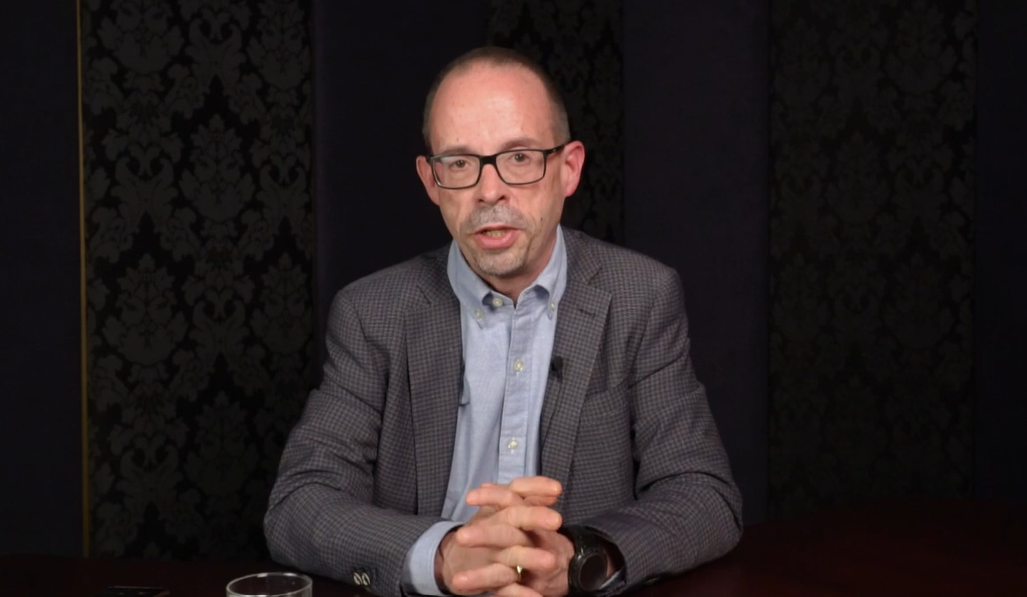
Imagine being a basketball player and Klay Thompson or Larry Bird tells you that he likes the form of your jump shot. That is what it felt like as a writer to receive a compliment from John Allen, the esteemed Catholic journalist who died earlier today.
One of the great honors I had when I edited Millennial full-time was being a panelist at the launch event for Crux at Boston College. Along with John, the event featured Cardinal Sean O’Malley of Boston, Ambassador Mary Ann Glendon, and professor Hosffman Ospino—an all-star lineup…plus me.
But when I arrived, his very kind words about my writing and Millennial put me at ease and made me feel as though I belonged. While other Catholic millennial publications sprang up, then disappeared, Millennial survived, and certain journalists played a key role in affirming our credibility and building our audience. Outside of Michael Sean Winters, John perhaps did the most. And his invitation to write regularly for Crux offered me a unique opportunity to reach new audiences and refine my skills.
John did not think young writers belonged at the kids’ table. He did not judge writers by their credentials, background, or affiliations but instead by their quality. He held himself and other writers to the highest standards. It is a legacy of excellence.
John Allen was an absolute rock star of Catholic journalism. I had read maybe seven of his books by the time he asked me to be on that panel. He was one of my favorite writers. His writing was so accessible, interesting, and well-sourced. He offered intricate, nuanced takes in his analysis.
His newswriting showed a devotion to impartiality that earned deep respect and credibility across the various lines that divide our polarized society. If you wanted to learn about the Cardinals who might be in the running to be the next pope, you had to read John Allen. Whether you needed small details or the big picture, he was on it. I tried to read every word that he wrote.
I am not alone in my admiration. Tributes are pouring in from his friends, colleagues, and others who know what a giant he has been for Catholic journalism in the US. And many are noting the key role John played in cultivating future generations of Catholic journalists.
Please say a prayer for John and his loved ones—and read some of the other things people are saying about this legend of Catholic journalism:
John never believed journalism was about winning arguments or pleasing audiences. He believed it was about fidelity — to facts, to sources, to context and ultimately to readers. For decades, he resisted the temptation to turn analysis into advocacy, insisting instead on explaining what each side believed and why, giving every reasonable position its day in court. Many resented him for that restraint. But no one ever doubted that what he reported was true, or exhaustively and honestly sourced….
He researched relentlessly. He traveled constantly. Rome was not a perch; it was a base camp. He went wherever the story demanded, determined never to explain the Church from afar. For him, covering the Vatican carried a responsibility akin to covering the White House: an honor bestowed on very few, with consequences that could not be taken lightly.
In that sense, John’s greatest “heritage” is not his legendary career, the prestige of the Crux website, or even the titanic impact he has had on journalism and the way the Catholic Church is understood and perceived in the world. It is the people he loved: it is me, our friends, our colleagues, and all of you. John’s greatest gift to the world was not his incredible and unparalleled mind, but it was his big and generous heart. Everyone who was blessed enough to call themselves John’s friend bore witness to his gift for friendship, his limitless self-giving, and his insatiable desire to help and empower others whenever and however he could. If he loved you, there were no lengths to which he wouldn’t go to help you or simply make your life easier. I hope that with his passing, the world will look back not just on his lifetime of impressive professional accomplishments, but more so, his personal ones.
Allen was a force of nature, certainly as a journalist who was not only our principal but also a model for us, whose counsel and whose company we already and forever shall sorely miss.
Allen was a patient mentor, a generous colleague, and the consummate newsman.
Keenly as we feel his absence in the newsroom, we also mourn the loss of a man who had been our dear friend for the better part of three decades.
Part of what made John a must-read during his early career was not just his clarity of style and the sense that he had his finger on the pulse of what was happening inside the Vatican, but that he also paid close attention to the often ignored aspects of Catholic life that would shape and reshape the institution in the decades to come. His 2012 book, The Future Church (one of 11 books he wrote on the Vatican and the Catholic Church), is a perfect testament to this and largely holds up today….
John — who never had kids of his own — often said that the young journalists he’d recruited had become his own children, or at least a piece of his legacy. Given that John began his career teaching high school in Los Angeles and serving as the faculty adviser to the student paper, John was most fulfilled when he was teaching and training the next generation. And I’ll never forget sitting next to John at a screening of a documentary about Pope John Paul II at the Angelicum in Rome. John, who had been raised in Kansas by a single mother, recounted through tears his own first encounter with the Polish pope as a defining moment in his life.
For a long time, my friend John Allen, who died today after a long battle with cancer, was one of the best Vatican reporters around, in any language. John consistently broke stories, offered incisive analysis, had the best sources and pulled it all together in clear, sparkling and often witty prose.
For those who weren’t around in those days, his omnipresence in the mainstream media is hard to describe: he seemed to be everywhere at once. John’s knowledge of the Vatican and of church history, as well as his familiarity with everyone from a cardinal-prefect of a Vatican dicastery to the newest papal appointee in a far-flung diocese, was nothing short of encyclopedic.
Working alongside John Allen at The Boston Globe and Crux was a masterclass in all things Vatican. On my first reporting trip to Rome, during the Synod on the Family in 2014, John dazzled me with his vast insight into what made the church tick and I remain grateful for his collegial generosity, particularly in throwing me several interviews with cardinals and bishops, offering a then newbie reporter a welcome surge of confidence. John was an entertaining, fun and deeply knowledgeable colleague and he’ll be missed.
Through his reporting and editorial choices, he made space for perspectives that some gatekeepers ignored. Even in his final weeks, his outlet Crux featured an interview about the future of the Catholic Left in America, ensuring our vision was heard in a major Catholic forum.
That was classic John Allen: ever even-handed, ever interested in the “Catholic pulse” of all the people of God.
John also had a special love for raising up new and young voices. One of the beautiful paradoxes of our Catholic tradition is that we honor our elders — popes and patriarchs are usually men of advanced age — yet we sometimes fail to listen to the young.
Too often there’s a kind of lay clericalism in the Church that sidelines fresh perspectives. John was a refreshing exception. He was a mentor to countless aspiring journalists and thinkers. He never acted as a gatekeeper guarding the old guard; instead, he opened doors.
He sought out perspectives from the global peripheries to the young and emerging thinkers.
He was a true pillar of Catholic journalism, especially in the English-speaking world, and his influence is impossible to overstate. For years, he offered readers a clear, levelheaded view of the Church as he understood it, grounded in his years of experience covering the Church and the friendships and contacts he made along the way. Even if you didn’t agree with everything he wrote, anyone who read John’s work regularly recognized that he was committed to presenting the facts objectively and representing all sides on every issue fairly and comprehensively. (And he was usually right.)
 Millennial