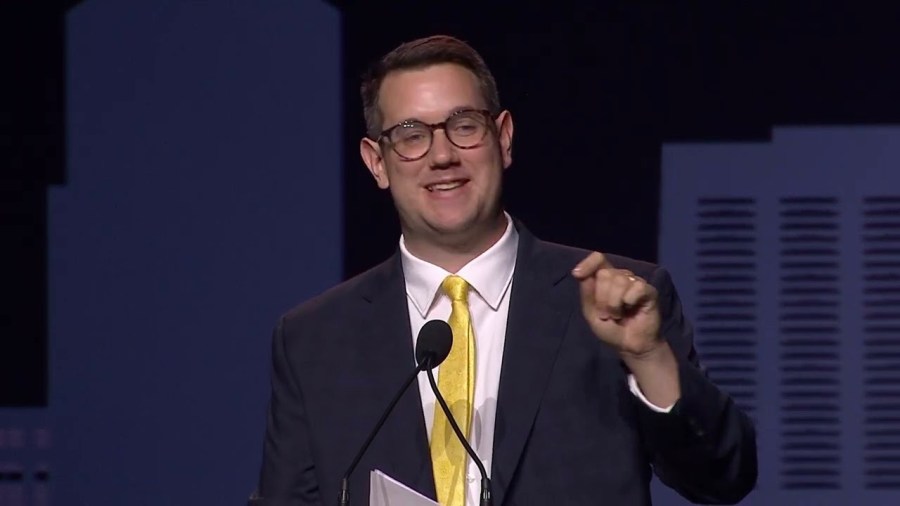
Chris Crawford is a policy advocate at Protect Democracy and a founding board member of The Center for Christianity and Public Life (CCPL). Millennial editor Robert Christian interviewed him on his work, his faith, and democracy.
Why should Catholics care about democracy?
We should care about democracy because we are about human dignity; we believe every person is made in the image and likeness of God. Having a voice in how our society governs itself is one way that we express that human dignity. Attempts to block access to voting are an assault on that dignity.
Democracies—especially ones with the constitutionally guaranteed rights that we have in our republic—are the best form of government to protect human rights and allow for human flourishing. In democracies, we have a system for solving disputes and settling disagreements. I like to say that every single freedom that we value—including our religious freedom—rests on the foundation of free and fair elections and a functioning democracy. Additionally, every issue that we care about depends upon the rule of law and functioning institutions.
One of the themes of Catholic Social Teaching is participation: “We believe people have a right and duty to participate in society, seeking together the common good and well-being of all, especially the poor and vulnerable.” We should take this obligation seriously as Catholics and protect democracy at this pivotal moment.
How can our country strengthen our democratic norms and institutions?
There are so many ways that we can strengthen our democracy, that my first advice is to find out where you want to get involved—and get started. With so much cynicism and fear in our politics, we need people who are willing to actually stand up and try to build institutions that can carry our country forward.
I worry that sometimes the term “democracy” gets politicized to the point that people think that strengthening democracy is only related to choosing one candidate over another. If that’s your contribution in 2024, you are not doing enough.
In the long term, we need to be creative about what the future of our democracy can look like. Our two-party system is failing us in a lot of ways, and I think we should look at ways that reforms such as fusion voting, ranked-choice voting, or approval voting could open up the system to new voices and new coalitions. The whole life movement could benefit especially well from such reforms.
In the short term, we need to realize the stakes in the 2024 election. We did not have a peaceful transfer of power in 2021. We have an election workforce made up of everyday people who are tired and under threat. We have candidates explicitly running campaigns to undermine the rule of law. People need to discern carefully about how they vote in 2024, and they need to determine the ways that they can serve our election infrastructure to help build trust and ensure the election runs smoothly.
Can people of faith and faith-based communities play a unique role in safeguarding and advancing American democracy?
I have two items I want to discuss on this front: 1) helping people discern how they vote and get involved in our public life, and 2) helping to ensure that our elections system works well.
First, I think that we need to recognize that a democracy requires people coming together to determine how to live together. As people of faith, and especially as Catholics, we have a framework for thinking about how the government can serve its people—especially the most vulnerable. Faith-based organizations can help people think carefully about the freedoms that we cherish, the value of pluralism, and how we want our society to operate. Too often, we only turn to partisans to tell us how to think about voting. We can go much deeper than that.
Second, I think that we have to recognize the organizing and unifying role that our faith communities can play as we prepare for the 2024 election. With trust in our elections dropping dangerously and polarization rising rapidly, we should be looking for ways that we can work together to increase trust in our democracy and in each other. In my work at Protect Democracy, we are partnering with Interfaith America to create a nonpartisan playbook to make it easy for faith-based communities to find ways that they can take action to support the 2024 election. This includes taking actions such as working as poll workers, having bridge-building conversations, meeting with election officials to better understand the election process, and other ways. Our churches are often trusted community organizations who can organize people to take action together. We should use our collective power to simply ensure that our 2024 election runs smoothly.
What is the Center for Christianity and Public Life (CCPL)—and why did you get involved with this organization?
The Center for Christianity and Public Life (CCPL) is a new, nonpartisan institution whose mission is to contend for the credibility of Christian resources in public life, for the public good. We offer what we have not as an act of imposition, but out of a spirit of loving service. We see politics as a way of loving our neighbor.
We also think that our democracy crisis is in many ways a spiritual crisis, and one that in many ways finds its root at a problem of discernment among American Christians.
Through fellowship programs, events, and public programming, CCPL is equipping Christians with the leadership development that they need to apply their faith to their public engagement in a way that is healthy and that serves the common good. It also is focused on making the case for this type of Christian engagement to the broader public.
I am involved because I have spent a lot of time at the intersection of Christianity and politics, including as a funder of projects related to Christianity and pluralism, and CCPL is the exact organization that I think has been missing from our public square. Michael Wear, our President and CEO, is a unique leader who can speak to Christians across political, racial, and denominational divides and he knows what it is like to live out one’s faith while serving in high office or a heated campaign.
How does your faith influence your life beyond work?
It influences my life in a lot of ways. It is at the center of my marriage and my role as a father. Having a child has really brought to life the importance of maintaining my relationship with Jesus and sharing the Gospel. I try (and fail, many times) to pray the Examen every night or every morning—a byproduct of my discerning the priesthood with the Jesuits before meeting my wife. On my best days, I try to see everyone in my life as a beloved child of God, including myself! That is sometimes difficult to do!
Earlier this year I became a Lay Cooperator with the Daughters of St. Paul. I joined because I love the Pauline charism. I think that the mission of spreading the Gospel and the unifying way that the order brings together different spiritual elements from many different Catholic religious orders and traditions is really beautiful. And the sisters are just wonderful, holy, joyful people. I look forward to continuing to grow in holiness through this new path that God has provided for me.
Why are you Catholic in 2023?
Jesus hasn’t left me and He never will. I have been blessed in my Catholic journey to have my faith grow in many different ways over time. I will admit that it does not grow in a linear way, and that there are many days of desolation and doubt. But I am a cradle Catholic. At different times my faith has reflected the different communities I have been a part of, whether that is my local parish growing up or my Newman Center in college. I had a period of time where I was really into Ignatian spirituality and almost become a Jesuit priest, times where I have been really inspired and committed most by social action, times when I am drawn to quiet prayer—and then a host of times where different saints or a Marian devotion have drawn me in. Since our miscarriage in 2020 and the birth of our son in 2021, I have found even more comfort in the intercession of Mary and Joseph. I’ve also gotten into the Memento Mori reflections as well as reading more by Henri Nouwen in recent years.
I think as this Millennial generation has lived through waves of disgusting sex abuse scandals in the Catholic Church, many of us have wanted to leave but have reminded ourselves: “Lord, to whom shall we go? You have the words of eternal life.” So, here we are. And as we rise into more leadership roles in our church, I think our generation is committed to rebuilding our church in a more just way, to lean on Christ even more, and to ultimately understand that we rely on Him more than He relies on us.
 Millennial