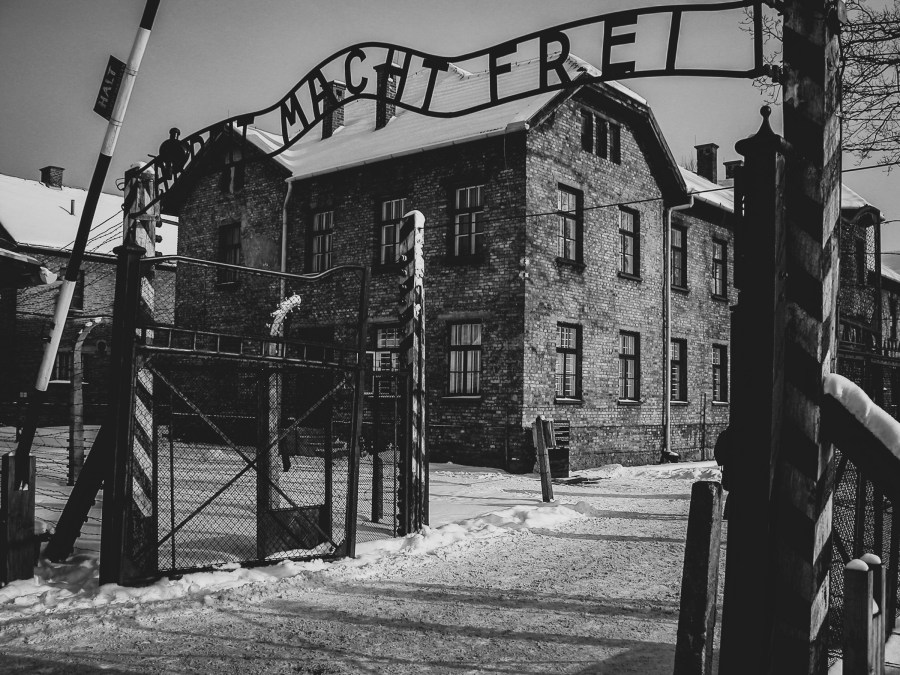
Meghan Clark writes:
In September, I visited Auschwitz-Birkenau for the first time. Studying and even teaching about the Shoah did not really prepare me to walk through the gates. Evil, pain, and horror filled the air as I stepped on ground made holy by the memory of the innocent victims brutally massacred there just over 75 years ago. “Your brother’s blood cries out to me from the ground,” says God to Cain as Cain tries to deflect responsibility for his brother’s murder (Gen. 4:11). Scripture swirled in my head as the tour walked us through the final brutal journey experienced by millions of our siblings during the Shoah….
It is easy to have moral clarity about the Shoah. It is harder to face questions of complicity in the centuries of Christian antisemitism that rendered the violence of Auschwitz possible among neighbors. It is even harder to face the persistence of Christian antisemitism within our community. At Mass on October 8, the evening after Hamas’ deadly attack, I heard a blatantly antisemitic homily in which a visiting priest blamed the Jews for the crucifixion and implied the Abrahamic covenant null. When I asked the priest if he had read the Second Vatican Council’s Nostra Aetate (Declaration on the Relation of the Church to Non-Christian Religions), he ignored the question, admitting he wrote the homily weeks ago. He acknowledged that given the news, it was insensitive. Ultimately, he was sorry that I was offended but saw no problem in the content of his homily. It is an example of the failure to think that clouds our vision of our neighbors’ dignity—in this case that of our Jewish siblings.
We must face the fact that Christian antisemitism is not relegated to history but persists today….
Antisemitism is rising. So too is Islamophobia. The increasing hate crimes are often rooted in hateful ways to identify the “other” as different by turning markers of religious identity into points for ridicule and demonization. As Catholics, we are called to love and to think. The gospel itself provides witness to Arendt’s assertion that only good is radical, not evil. It calls us to remember, in the words of Auschwitz survivor Roman Kent, “Hate is never right, and love is never wrong.”
 Millennial