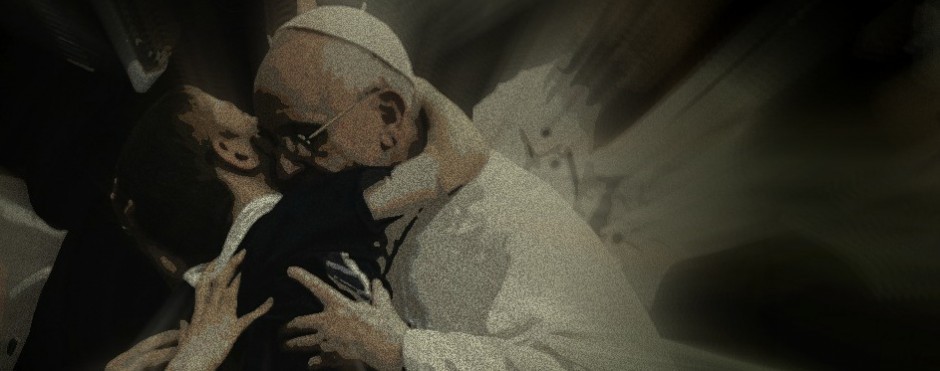
via Vatican News:
At 9:45 AM, Cardinal Kevin Farrell, Camerlengo of the Holy Roman Church, announced the death of Pope Francis from the Casa Santa Marta with these words:
“Dearest brothers and sisters, with deep sorrow I must announce the death of our Holy Father Francis. At 7:35 this morning, the Bishop of Rome, Francis, returned to the house of the Father. His entire life was dedicated to the service of the Lord and of His Church. He taught us to live the values of the Gospel with fidelity, courage, and universal love, especially in favor of the poorest and most marginalized. With immense gratitude for his example as a true disciple of the Lord Jesus, we commend the soul of Pope Francis to the infinite merciful love of the One and Triune God.”
Michael Sean Winters on “Pope Francis’ remarkable pontificate”:
On March 13, 2013, even before the new pope appeared on the loggia of St. Peter’s minutes after being elected, the first inkling that his would be a different kind of pontificate, and a stunning inkling at that, was his choice of name: Francis.
He was the first pope to take the name of the beloved medieval saint whose commitment to poverty and to the poor commenced the greatest reform in the long history of the church. We would later learn that the choice of name was inspired by his friend Brazilian Cardinal Claudio Hummes who, once his election became clear, whispered to him, “Don’t forget the poor.” He never did.
One way to understand this pontificate is to view it as a gradual unpacking of the significance of his choosing the name Francis.
When Pope Francis came out onto the loggia a few minutes later, he began with the words, “Fratelli e sorelli, buona sera. Brother and sisters, good evening.” He was introducing himself to his new worldwide flock not as the sovereign pontiff but as a brother, and fraternity would be a theme of his magisterial teachings. The common greeting “buona sera” displayed a common touch, as did his appearance in a simple white cassock. Here was an approachable, quotidian personality, more pastor than prophet, a man who intended to accompany the people of God. And he always did….
The first pope from the Global South, the pope challenged those of us in the wealthy Western nations to examine our lives and our luxuries, especially the luxury of endless debates about what does and does not make one a good Catholic. “Todos, todos, todos,” became a theme of his ecclesiological vision, but he never failed to remind us that in the kingdom of God, it is the Lazaruses of the world (cf. Luke 16:19-31), the poor and forgotten who are privileged and that it remains easier for a camel to pass through the eye of a needle than for a rich man to get into heaven.
Decades and centuries hence, the election of the Archbishop of Buenos Aires, Cardinal Jorge Mario Bergoglio, as pope will be seen as a turning point, a confirmation that the center of gravity in global Catholicism had moved south of the Equator. The implications of that shift are difficult to discern, but one thing is obvious: Catholicism will again be a church of the poor.
The first Jesuit pope was, like most Jesuits, a teacher, but so much of Pope Francis’ teaching was achieved by gestures. Early in his pontificate, he ordered the popemobile to stop so he could embrace a man whose body was severely deformed. Pope Francis, moved by the plight of migrants, made his first papal trip to Lampedusa, the island halfway between Tunisia and Malta where many Arab and African migrants landed in search of a better life. In all his papal trips he made visiting the poor a priority and, in a nod to his Jesuit identity, always had a gathering with the local community of the Society of Jesus. The transcripts of his visits with his fellow Jesuits always revealed a man deeply rooted in his Ignatian identity….
Of all the many qualities of this extraordinary man, Francis had a knack for engaging children. As I think back over the past 12 years, the most quintessential moment of this papacy came on a parish visit. A little boy, Emanuele, went to the microphone to pose his question to the pope, but the boy was consumed with tears. The pope beckoned him — “Vieni, vieni” — and embraced him for a long time. The little boy whispered his question to the pope: He wanted to know if his father, who was an atheist and recently died, had gone to heaven. The pope assured the boy that God does not abandon a good man.
What really showed how Pope Francis was able to embody our dogmatic belief in the dignity of every human person, was this: Before he shared the boy’s story, the pope said, “If only we could cry like Emanuele when we have pain in our hearts.” Francis pointed out how even a little boy’s tears can humanize us and, in a way, evangelize us. Francis also noted that he had asked Emanuele’s permission to share his story with the gathered community, a profound mark of respect for the little boy’s dignity. In this long pontificate, filled with so many beautiful moments, his encounter with Emanuele was the one that most touched my heart.
I am not someone who cries easily but I confess I have gotten choked up several times while trying to pen this reflection on his papacy. Watching the video of Pope Francis with little Emanuele opened the floodgates. Everyone admired Pope Benedict for his soaring intellect, and Pope John Paul II for his courage and tenacity. Pope Paul VI was the greatest pope of the 20th century, the man who brought Vatican II to a successful conclusion and began its implementation. Not since 1963, when Pope John XXIII died, has the Catholic world mourned a pope not primarily with admiration, but with affection. Francis touched our hearts.
John Allen on the “electrifying, maverick Pope Francis”:
Within days, however, the new pontiff had established a narrative about himself which utterly electrified public opinion, and which would endure to the very end: A humble, simple man of the people, “the world’s parish priest,” who spurned luxury and privilege in favor of proximity to the underdogs and the excluded.
This was the pontiff, after all, who took the name “Francis” in homage to Catholicism’s most iconic and beloved saint, the “little poor man” of Assisi; the pope who rejected the marble and gold of the Papal Apartments in favor of the Domus Santa Marta, a modest hotel on Vatican grounds; the pope who returned to the clerical residence where he’d stayed prior to his election to pack his own bag and to pay his own bill; and the pope who, 15 days later, spent his first Holy Thursday not in the ornate setting of St. Peter’s Basilica, but at a youth prison in Rome where he washed the feet of 12 inmates, including two Muslims and two women….
At his best, Francis led a great “pastoral conversion,” emerging as the “Pope of mercy” who reminded the Church that the sabbath is made for man, not man for the sabbath. In service to that spirit, he often seemed to positively radiate a spirit of Christian love.
In November 2013, for example, during a routine Wednesday General Audience, Francis caught sight of Vinicio Riva, a 53-year-old Italian man suffering from a severe case of neurofibromatosis which leaves his body covered from head to toe with growths, swelling and sores. Unlike most people, who cross streets to avoid coming into contact with Riva, Francis made a beeline and wrapped him in a tight embrace that seemed to go on much longer than a simple photo op would have required.
“He didn’t have any fear of my illness,” Riva said afterwards. “He embraced me without speaking … I quivered. I felt a great warmth.”
Such moments were core features of the papacy, from beginning to end.
When Francis left Rome’s Gemelli Hospital in 2023 after being treated for bronchitis, he ran into Serena Subania and Matteo Rugghia, a Roman couple who had just lost their five-year-old daughter to a debilitating genetic illness the night before. Subania pressed her head into the pope’s chest and wept, as he held her close and whispered words of consolation….
When Cardinal Jorge Mario Bergoglio of Buenos Aires, Argentina, took over the papacy, the Catholic Church stood at an historical crossroads. With its social capital drained by centuries of secularization, and its moral standing badly compromised by decades of clerical sexual abuse scandals, the Church seemed adrift.
All that changed swiftly under Francis, whose maverick style and progressive agenda captured the imagination of the world and never let go. From migrant and refugee policy to climate change to the war in Ukraine, there wasn’t a major global debate in which Francis’s voice went unheard.
In a phrase, this was a pope who mattered….
In effect, Pope Francis was that man singing in our time, even if his tune wasn’t always music to everyone’s ears. This pontiff from “the ends of the earth” sent forth an army of “missionaries of mercy” from the besieged garrison that had been the Catholic Church prior to his election.
If his army encountered opposition, including from within, and if his campaigns met with only limited and mixed success, they nevertheless achieved a massive scattering of seed destined to continue to flower in unpredictable, and often disruptive, ways.
Pope Francis, to repeat, mattered. For any leader, it’s hard to imagine a better epitaph than that.
 Millennial