Pope Leo XIV via the Vatican:
- While in past ages there were Christian writings — influenced by dualistic philosophies — that had a rather negative view of the body, mainstream Christian theology emphasized the goodness of the material world, affirming that the human person is a unity of spirit, soul and body.
- According to Thomas, the virtuous life concerns not only work or serious responsibilities, but also time for games and rest.
- Some social science scholars can help us better understand the human and cultural significance of sport and, consequently, its spiritual significance. A relevant example is research on the so-called “flow experience” in sport and other areas of culture. This experience typically occurs among people engaged in an activity that requires concentration and skill, when the level of challenge matches or slightly exceeds their already acquired level. Consider, for example, a prolonged rally in tennis: the reason this is one of the most enjoyable parts of a match is that each player pushes the other to the limit of his or her skill level. The experience is exhilarating, and the two players challenge each other to improve; this is as true for two ten-year-olds as it is for two professional champions.
- Numerous studies have recognized that people are not only motivated by money or fame, but can also experience joy and rewards intrinsic to the activities they perform, namely by accomplishing them and appreciating them for their own sake. In particular, it has been observed that people experience joy when they give themselves fully to an activity or relationship, progressing beyond where they were. Such dynamics promote the growth of the person as a whole.
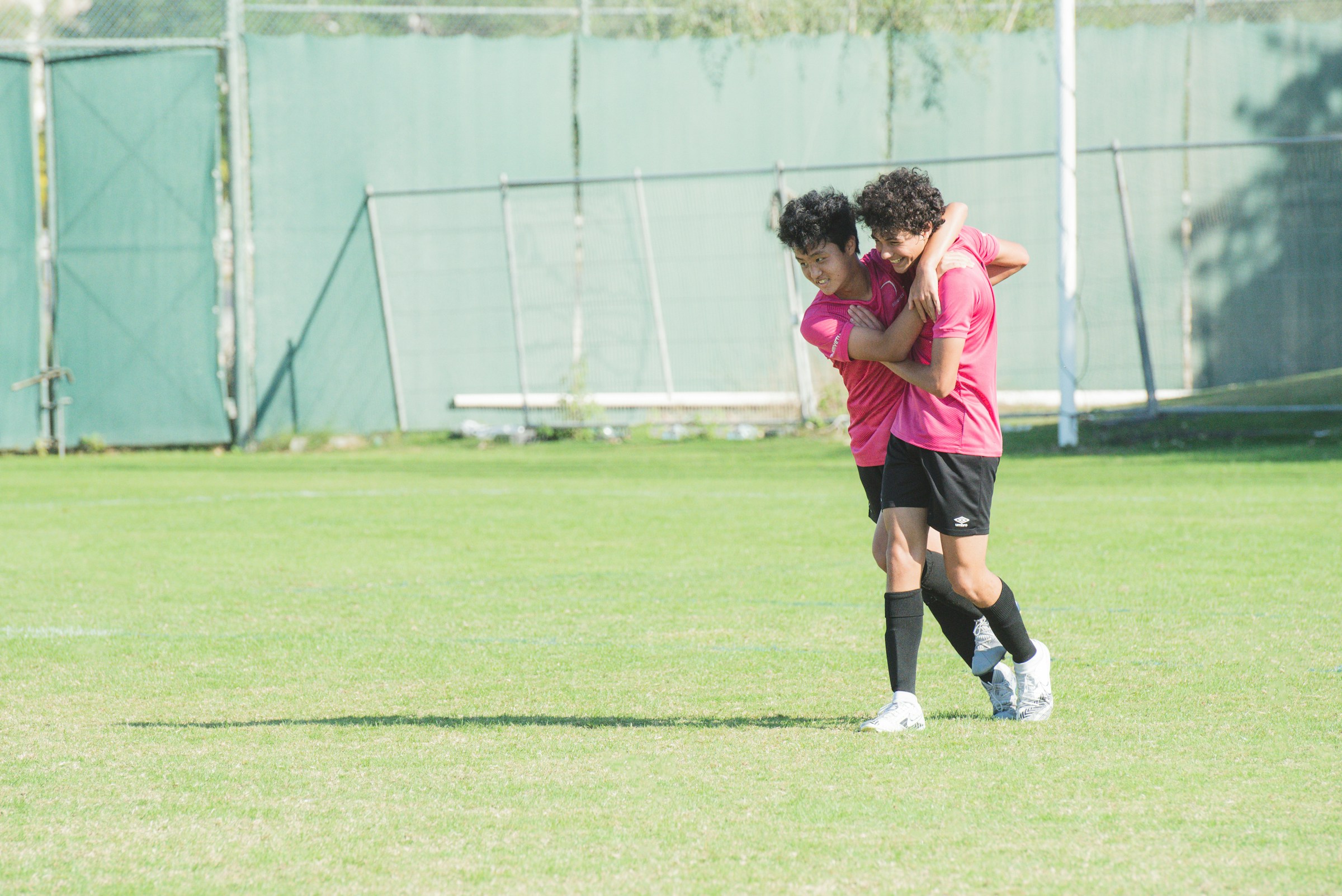
- Furthermore, while engaging in sport, people often focus their attention completely on what they are doing. There is a fusion between action and awareness, to the point that there is no room for explicit attention to oneself. In this sense, the experience reduces the tendency towards egocentricity. At the same time, people describe a sense of union with their surroundings. In team sport, this is usually experienced as a bond or unity with teammates. The players are no longer focused on themselves because they are part of a group working towards a common goal. Pope Francis repeatedly emphasized this aspect when encouraging young athletes to be mindful of their teammates.
- When team sports are not polluted by the worship of profit, young people “put themselves on the line” in relation to something that is very important to them. This is a tremendous educational opportunity. It is not always easy to recognize one’s own abilities or understand how they can be useful to the team. Moreover, working together with peers sometimes involves dealing with conflicts and managing frustrations and failures. They even have to learn to forgive (cf. Mt18:21-22). In this way, fundamental personal, Christian and civic virtues take shape.
- Coaches play a fundamental role in creating an environment in which these dynamics can be experienced, accompanying the players through them. Given the human complexity involved, it is a great help when a coach is guided by spiritual values. There are many coaches of this kind in Christian communities and other educational settings as well as at the competitive and professional elite levels. They often describe the team culture as one based on love, which respects and supports each person, encouraging individuals to do one’s best for the good of the group. When a young person is part of such a team, they learn something essential about what it means to be human and to grow. In fact, “it is only together that we can become our authentic selves. Only through love does our inner life become profound and our identity strong.”
- Furthermore, it is important to remember that, precisely because sport is a source of joy and promotes personal development and social relationships, it should be accessible to all who wish to participate. In some societies that consider themselves advanced, where sports are organized according to the principle of “pay to play,” children from poorer families and communities are excluded because they cannot afford the participation fees. In other societies, girls and women are not allowed to participate in sports.
- When the objective is to maximize profit, what can be measured or quantified is overvalued to the detriment of the incalculable and important human dimensions…This mentality creeps into sport when attention is obsessively focused on results and the monetary rewards that winning can bring. In many cases, even at the amateur level, commercial demands and values have come to overshadow the human values of sport that ought to be safeguarded.
- When financial incentives become the sole criterion, individuals and teams may also fall prey to subjecting their performance to the corruption and influence of the gambling industry. Such dishonesty not only corrupts sporting activities themselves, but also demoralizes the general public and undermines the positive contribution of sport to society as a whole.
- For this very reason, authentic sporting competition presupposes a shared ethical accord: the sincere acceptance of the rules and respect for the integrity of the contest. Rejecting doping and all forms of corruption, for example, is not merely a disciplinary issue, but one that touches the very heart of sport. Artificially altering one’s performance or buying results breaks the essence of cum-petere, turning the shared pursuit of excellence into the subjugation of individuals or groups.
- In this sense, sport offers valuable lessons that extend beyond the playing field. It teaches us that we can strive for the highest level without denying our own fragility; that we can win without humiliating others; and that we can lose without being defeated as individuals. Fair competition thus safeguards a deeply human and communal dimension. It does not divide, but brings people together; it does not focus solely on the result, but values the journey; it does not idolize performance, but recognizes the dignity of those who play.
- Sport thus teaches us a deeper understanding of life, in which success is never definitive and failure is never the last word. Learning to accept defeat without despair and to welcome victory without arrogance enables athletes to face reality in a mature way, recognizing their own limits and possibilities.
- The cult of image and performance, amplified by media and digital platforms, risks fragmenting the person, separating body from mind and spirit. There is an urgent need to reaffirm integral care of the human person; physical wellbeing cannot be separated from inner balance, ethical responsibility and openness to others. We need to rediscover those who have combined passion for sports, sensitivity to social issues and holiness.
- When sport succumbs to the mentality of power, propaganda or national supremacy, its universal vocation is betrayed. Major sporting events are meant to be places of encounter and mutual admiration, not stages for the affirmation of political or ideological interests.
- Despite these dangers, sport possesses an extraordinary capacity for inclusion. When played correctly, it creates opportunities for participation for people of all ages, social conditions and abilities, thereby serving as an instrument for promoting integration and dignity.
- In particular, the harmony between physical and spiritual development should be considered a constitutive dimension of an integral vision of the human person. Sport thus becomes a place for athletes to learn to take care of themselves without falling prey to vanity, to push themselves to their limits without harming themselves and to compete without losing sight of fraternity.
- Another decisive task is reflecting and implementing sporting practices as open and inclusive instruments for communion. Sport can and must be a welcoming space, capable of involving people from different social, cultural and physical backgrounds. The joy of being together, which comes from shared play, common training and mutual support, is one of the simplest and most profound expressions of a reconciled humanity.
- Their daily experience speaks of asceticism and sobriety, of patient efforts to improve, of balance between discipline and freedom and of respect for the rhythms of the body and mind. These qualities can illuminate one’s entire social life.
- All this finds its ultimate meaning in the biblical promise that gives this letter its title: life in abundance. This is not an accumulation of successes or performances, but a fullness of life that integrates our bodies, relationships and interior lives. In cultural terms, life in abundance invites us to liberate sport from reductive mentalities that would transform it into a mere spectacle or product.
 Millennial