There is a temptation, reading Pope Leo XIV’s letter on artificial intelligence, to hear its two cities — Babel and Jerusalem — as a simple contrast between pride and humility, or between technology baptized and technology refused. But the deeper distinction the Holy Father draws is political, and it is the one I want to dwell on: the difference between homogeneity and communion. Babel is unity by sameness — “a single language, a single technology, a single direction,” a uniformity that, in his words, neutralizes difference. Nehemiah’s Jerusalem is unity by participation: a wall rebuilt because each household is given its own section, a people who rediscover a common language that is not uniformity but communion. When the encyclical turns, in its section on building for the common good, to the architecture of a flourishing city, it is describing — whether or not it uses the word — the labor of democracy.
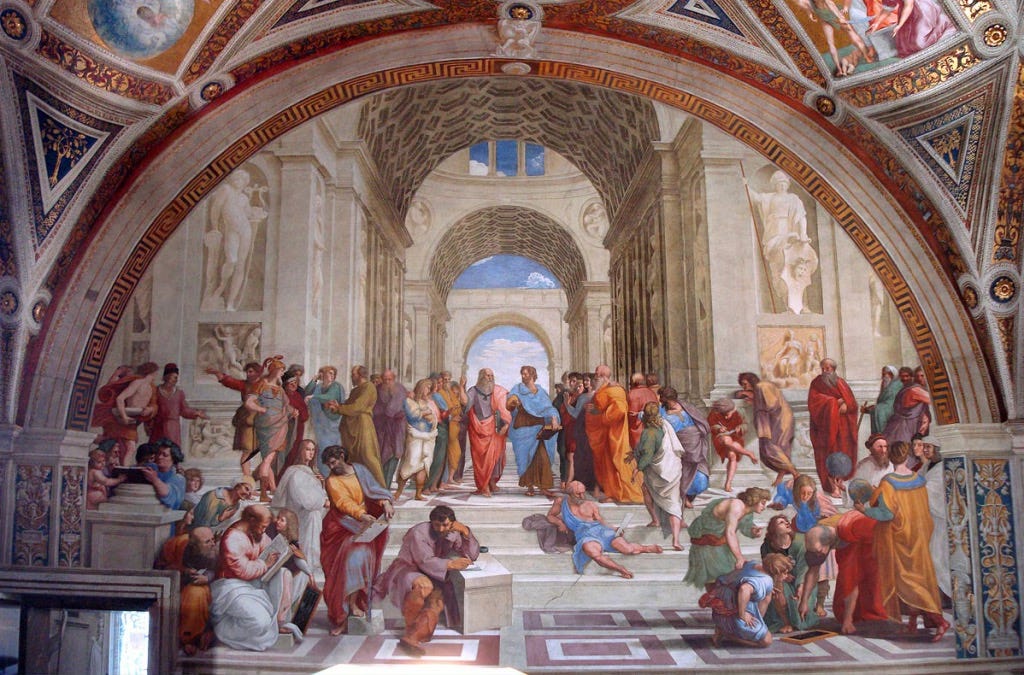
That distinction is older than the encyclical, and political thought has been worrying it for two and a half millennia. Plato’s Republic is the purest dream of Babel: a city made one by the dissolution of the family, the silencing of the appetites, and the assignment of each soul to its caste — unity purchased at the price of difference, and finally at the price of the person. It was Aristotle who named the flaw. A city, he insisted against his teacher, is by its nature a plurality; to force it into the unity of a single household or a single soul is not to perfect it but to destroy it. The city lives as a community of households, its oneness composed of its differences rather than achieved against them. Here, at the very beginning of the tradition, is the encyclical’s claim in classical dress: communion is not the elimination of plurality but its right ordering.
Hannah Arendt gave this insight its modern and most unsettling form. Plurality, she held, is the very condition of political life — that men, and not Man, inhabit the earth — and the characteristic ambition of every tyranny is to abolish it, to compress the many into one. She had watched her own people offered emancipation on precisely those terms: legal equality in exchange for the quiet erasure of their difference, citizenship conditioned upon assimilation. That, too, is a Babel — a tower whose single language can admit you only if you consent to stop being yourself. And it is exactly the danger Leo XIV names when he warns against the pretense that a single language, even a digital one, could reduce the person to “data and performance.” The new homogenization does not march; it optimizes. It flattens the person into a profile and the citizen into a datapoint, and it calls the result unity. It is Babel in a server farm.
If Babel is the concentration of power in a single tower, then the wall of Nehemiah is its rebuke — and so is democracy. The encyclical’s third pillar of the common good is that “all are given their own section of the wall”: scientists and legislators, workers and civil society and faith communities, each bearing a part. This is what the tradition calls subsidiarity, and it amounts to a theology of dispersed power. Robert Bellarmine and Francisco Suárez argued, against the divine right of kings, that authority is mediated through the community and remains accountable to it; Thomas Aquinas defined the tyrant precisely as the one who rules for his own good rather than for the common good. The genius of democracy is to take this conviction and build with it — to divide the labor of governance among many hands so that no single hand may close around the whole. Which is why the encyclical’s warning about power should trouble anyone who cares about self-government: it observes that technological power has become private, gathered into transnational actors whose resources surpass those of many governments. That is a new tower rising on the plain of Shinar. To insist that such power be answerable — dispersed, transparent, subject to the people it governs — is not hostility to progress. It is the way of Nehemiah.
Two further conditions make communion possible, and democracy depends on both. The first is the acceptance of weakness. The encyclical refuses to treat human limitation as an error to be corrected, and that refusal is the ground of equal dignity. If our worth were indexed to our capacities — our productivity, our data, our performance — then the weak would simply be worth less, and the city would have a use for some persons and none for others. A democracy built on the imago Dei begins instead from the conviction that dignity is neither earned nor optimized away. The second condition is language. Leo XIV calls for an evangelical language that refuses humiliating and antagonistic words, and here the most secular of my interlocutors agrees with him. John Rawls held that a society cannot be made homogeneous without excessive government force, that moral and religious pluralism is the mark of a healthy civil order, and that what binds such plurality together is not sameness but the political virtues: civility, reasonableness, the willingness to offer reasons a neighbor can actually hear. Moses Mendelssohn had embodied this two centuries earlier, insisting that he could be a full citizen without surrendering his particularity — communion, in Martin Buber’s phrase, as being “together with” the other rather than dissolved into him.
This, finally, is what democracy is for. Not to manufacture agreement, and still less to manufacture sameness, but to be the wall on which a plural people builds a common home. The age of artificial intelligence will press us, relentlessly, toward Babel — toward the single platform, the single language, the optimizing logic that promises unity and yields dispersion. The encyclical’s wager, and mine, is that the human person is not a problem efficiency can solve, and that a city worthy of the name is built the slow way: each at their own section of the wall, in the presence of God, refusing to be made one by being made the same.
Meghan Goodwin is an ethicist, educator, and the founder of Common Good Futures. For more of her reflections on Catholicism, Democracy, and AI, check out her substack here.

