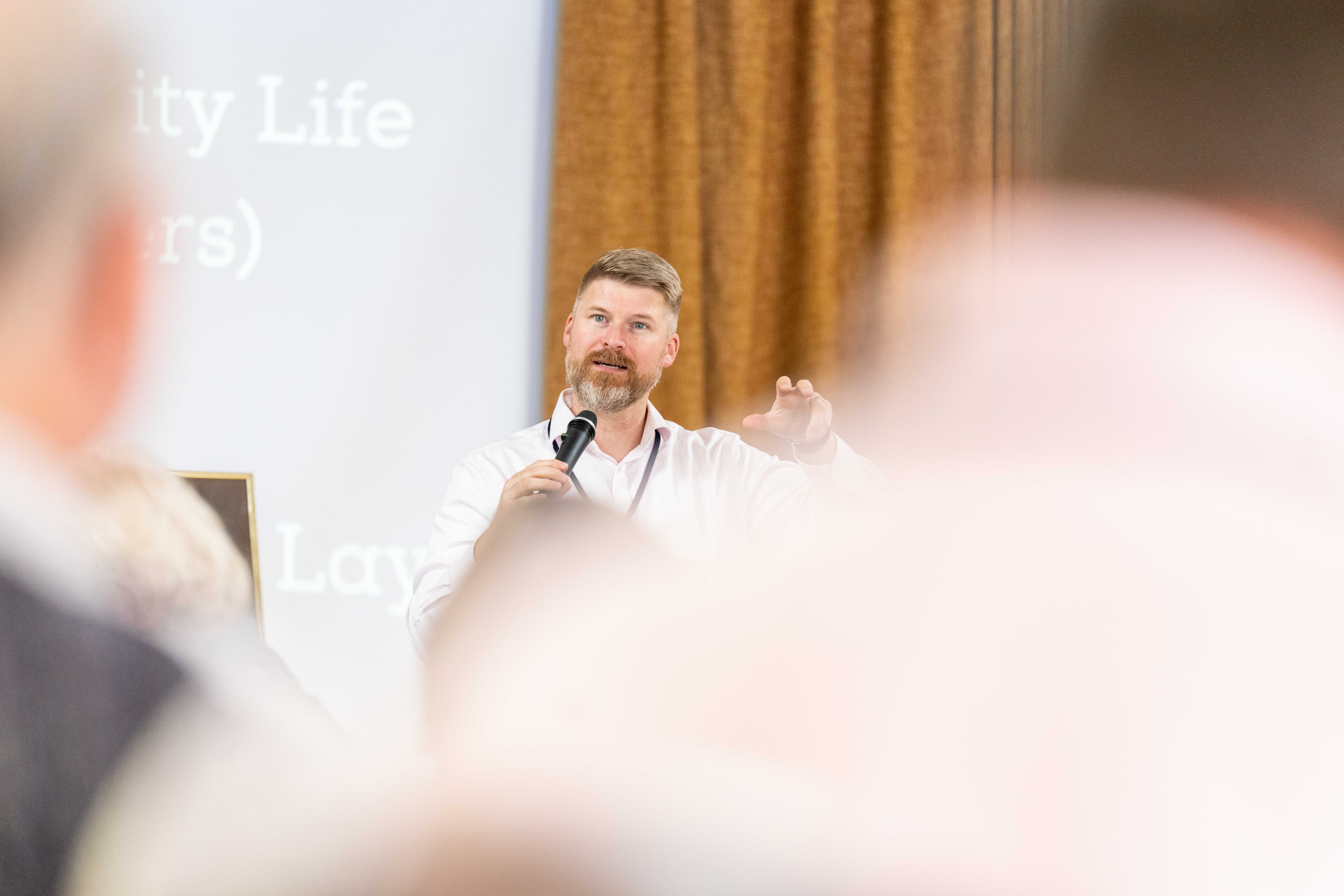
Millennial editor Robert Christian interviewed Jonathan Lewis, Mission Strategy Officer for the Paulist Fathers and Co-Director of the Communion Project, on his work, depolarization, digital engagement, and his faith.
What is the Communion Project? Why was it created?
The Communion Project is a movement that seeks to lower the temperature of division and polarization among Catholics. The Paulist Fathers began the project after seeing how polarization, tribalism, and divisions were dulling the joy of the gospel and our Catholic witness in this country. We believe that by addressing this distrust and division we can help the Church be a more effective, united, and joyful witness. Pope Leo XIV was also a major inspiration. At his Installation Mass he said, “Brothers and sisters, I would like that our first great desire be for a united Church, a sign of unity and communion, which becomes a leaven for a reconciled world.”
Our strategy is to equip Church leaders with the tools and resources they need to bring Catholics together across differences and to model how we can live together as brothers and sisters living unity in diversity day in and day out. So, we’re gathering and creating tools for self-reflection, prayer, and discernment that help hone the skills to have charitable discussions or even disagreements without devolving into distrust and division.
If someone says, “Polarization is bad, but the problem is that one party believes it’s fine to allow the legal killing of millions of unborn children” or “Polarization is a problem, but there is nothing we can do because one party is devoted to a corrupt, wannabe dictator who is hunting down our neighbors, dismantling environmental protections, and gutting assistance to those in need,” how would respond?
I would say that building communion does not have a litmus test and it is not primarily a strategy for accomplishing any goal or end, even if it is a very good one. The work of building communion is about our own identity as Catholics and how to be faithful to the Gospel. Saint Augustine said that we are to “become what we receive,” that is, we are called to be the Body of Christ together. When we see each other as members of our own body, it should change how we interact with one another, in person and online.
In this way, addressing polarization and building communion is primarily about our own spiritual journey, it disabuses us from thinking that we can accomplish it on our own without God’s grace or that it is primarily our work. This project is about opening us up to grace and conversion, starting with me.
The fields of politics, marketing, and business may teach us to defeat, outmessage, or outearn those we disagree with. These fields can offer tools to help us promote the Gospel, but only if we remain rooted in a sacramental imagination that sees others as brothers and sisters. Without that grounding, we devolve into serving the city of man instead of the city of God.
Pope Leo XIV is such an inspiration in this work. In his encyclical “Magnificent Humanity” Pope Leo contrasts these two cities in the scriptural cities of Babel and Jerusalem. He says that “the primary choice is not between a “yes” or “no” to technology, but rather between constructing Babel or rebuilding Jerusalem; between a power that claims to dominate the heavens and a people who work together in the presence of God to rebuild the walls of fraternal coexistence.” He places in contrast that Babel is characterized by “the spread of a culture of power characterized by polarization and violence.” while “Jerusalem rediscovers a common language — not one of uniformity, but one of communion, namely the harmony that arises when all persons assume their own role and recognize that their strength comes from the Lord.” In summary, he says, “the task that stands before us is that of being builders of communion, rather than architects of Babel.”
You have a strong background in digital engagement and working with young people in Catholic spaces. Do you have any advice for people working in these areas?
My first instinct is to tell people to log off of platforms driven by algorithms. Too often division and distrust are built into the business model. I think what is particularly important these days is to increase the amount of time we’re spending in face-to-face conversations with people. This means investing in local organizations like parishes, taking in person classes or joining clubs. We have to find ways to rebuild social trust and social friendship and that starts with each of us putting our phones away and becoming trustworthy and friendly people in person.
I also think it is helpful for each of us to do a regular audit or examination of conscience on our digital lives and footprints. Are we reading and listening to media that challenges are our perspective or only those that confirm our particular point of view? Are we more likely to post something online that is clever even if it is uncharitable? If we have a concern, do we reach out to the person directly or post it publicly for the sake of likes or content? Do we think of ourselves as so important that we have to comment on any issue in the Church or world even if it does not relate to us?
I know you’re a big Henri Nouwen fan. What are some of his ideas or messages that you find so compelling and relevant?
I think Henri Nouwen is a saint for our modern times. The first thing that stands out to me about his life is not his writing or speaking, which made him famous, but rather how he chose to live the last decade of his life, hidden and in service. Our public life, and sadly our Catholic life in this country, is so driven by celebrity Catholicism and influencer culture. Henri himself had a table set for him to be a Catholic celebrity but instead, chose to live the last decade of his life in a community of persons with intellectual disabilities. This is a community that most of the world ignores or avoids as not important or successful enough, but that Henri embraced.
Henri’s friendship and accompaniment with a community member named Adam is an invaluable example of the culture of encounter and the art of accompaniment that Pope Francis taught as essential dimensions of our work of evangelization. It was not flashy, it was not done on a stage or livestreamed to thousands, it was humble, inconvenient, gentle and sacrificial. His actions beautifully reinforced his great writing and teaching on the dignity of the human person or as Nouwen would say, about the belovedness of each person as a son and daughter of God. I highly recommend Catholics to read his book The Life of the Beloved as a great starting point for getting to know one of the great spiritual masters of the 20th century.
How does your faith impact your life outside of work?
I hope that the way I live my life is reflecting the joy of the Gospel to those I meet. Most fundamentally, my faith impacts the way that I live as a husband and a father. Like Nouwen’s ministry at the end of his life, family life is one of those hidden, humble, inconvenient, gentle, and sacrificial missions. And no matter what I ever accomplish professionally, it will always be my most proud and important work.
My wife and I chose Galatians 5:22 as one of the readings for our wedding Mass. The passage recounts St. Paul sharing the Fruits of the Spirit: love, joy, peace, patience, kindness, goodness, faithfulness, gentleness, and self-control. We repeat these regularly in our house, and I hope that I can impact my family and community by living these well. I have a long way to go!
Why are you Catholic?
I am Catholic because I believe that God created each of us and the whole world as good and beautiful. Throughout my life I have seen the diverse ways that God continues to reach out to us throughout history and still today. I am Catholic because I believe the Catholic Church is the Bride of Christ, nourished by Christ’s sacrifice made present in the Eucharist. I am Catholic because I believe the Church continues to be led by the Holy Spirit to carry on the saving mission of Jesus Christ to feed the hungry and clothe the naked and make disciples of all nations. I am Catholic because of my mother and father who first modeled to me and taught me the Catholic faith and how to serve others. I am Catholic because of the witness of the Saints, those canonized and those unknown ‘middle class’ saints in my life (as Pope Francis said) who showed me the manifold ways of living like Jesus Christ today that is heroic.

